

What is the spend-based method for calculating Scope 3 emissions?
Emission factors are typically expressed as an amount of emissions per monetary unit, for example, kg CO₂e/€ or t CO₂e/million euros.
This approach is included in the GHG Protocol guidance for calculating Scope 3 emissions. It is particularly relevant for categories such as:
- Category 1. Purchased goods and services.
- Category 2. Capital goods.
The financial information available in procurement records or ERP systems can therefore be used to build an initial estimate of the emissions associated with large volumes of purchases.
What are monetary emission factors?
Unlike a physical emission factor (for example, kg CO₂e per kg of material, product unit, or km travelled), a monetary emission factor relates the emissions generated by an economic activity to its economic value.
This makes it possible to work with information that companies usually have more readily available:
- Purchase amount.
- Purchased product, service, or category.
- Supplier company.
- Associated country or market, where this information is available.
- Cost centre, legal entity, or business unit.
Each type of purchase requires an emission factor that reflects its characteristics. Machinery manufacturing, IT services, chemical products, or professional services, for example, have different production structures and emission profiles. For this reason, a key part of the calculation is to correctly match each purchase with the economic activity that best represents it.
What is EXIOBASE?
EXIOBASE is a multi-regional Environmentally Extended Input-Output (EE-MRIO) database. It integrates economic information on the relationships between production sectors and countries with environmental information on aspects such as emissions and resource use.
In simplified terms, it makes it possible to analyse the direct activity of an economic sector and the relationships throughout its supply chain. This feature means that models of this type can be used to develop emission factors associated with economic expenditure, linking a specific purchasing activity to a sector and geographical context.
For example, the purchase of certain industrial components has different characteristics from the procurement of professional services. Even within the same type of purchase, the production and geographical context can influence the estimate.
From procurement data to an emissions estimate
This approach makes it possible to work with datasets containing anything from hundreds to tens of thousands of records without initially requiring detailed physical information for each purchase.
The quality of the result depends on factors such as the quality of the source data, the correct classification of purchases, the suitability of the emission factors used, and consistency across the years and economic units considered. Therefore, applying a spend-based approach involves appropriately segmenting expenditure, assigning representative emission factors, and maintaining methodological consistency across different periods and economic units.
Can any company apply this tax deduction?
The regulatory provisions establish, as a general rule, that in order to apply the tax deduction under Article 65.1(f), the company’s activity must be different from the professional activity of waste management.
An exception applies to certain investments in facilities or equipment intended for recycling and material recovery that, among other requirements, achieve a material recovery rate of at least 80%, comply with market requirements for the resulting products, contribute to industrial decarbonisation, and hold the corresponding environmental authorisation.
For an industrial company whose main activity is not professional waste management, the analysis should focus primarily on verifying that the investment and its intended purpose effectively fall within the scope of Article 65.1(f).
When is a spend-based calculation particularly useful?
The method can be useful in a wide range of situations:
When the company is starting to calculate its Scope 3 emissions
It provides broad initial coverage of purchases even when product- or supplier-specific information is not yet available. This helps identify which activities potentially account for the largest share of emissions and where it makes sense to focus additional data collection efforts.When there are thousands of purchases or suppliers
Requesting physical data or specific carbon footprints for every purchase from the outset may be unrealistic. A monetary approach provides initial coverage of the full range of purchases and helps establish priorities.When a Scope 3 calculation is already in place
It may also be necessary to review an existing methodology. The use of highly aggregated factors, poorly representative classifications, outdated sources, or insufficiently documented assumptions can significantly affect the results. In these cases, reviewing the model can improve its traceability, consistency, and analytical value.What can the analysis of the results provide?
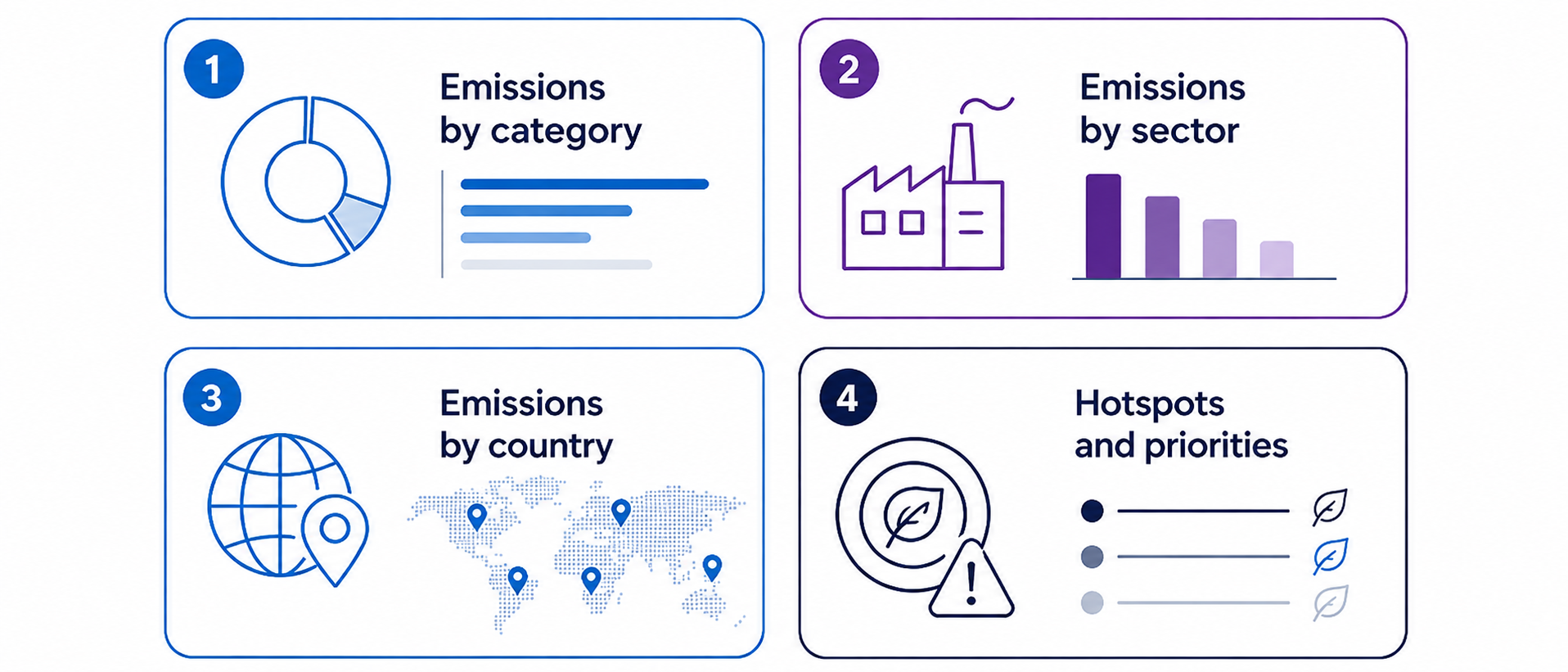
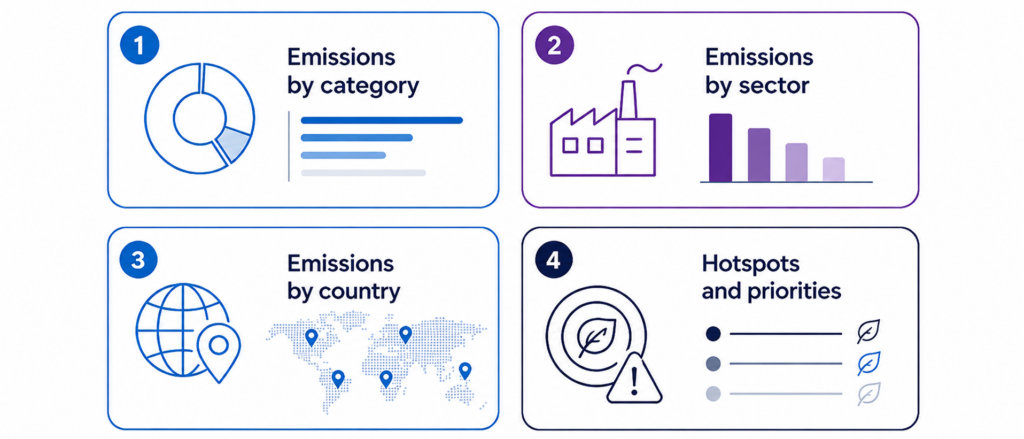
In addition to providing an overall emissions estimate, properly structuring procurement data makes it possible to analyse where supply chain impacts are potentially concentrated.
Depending on the information available, results can be analysed by:
- Purchasing categories.
- Economic sectors.
- Countries or regions.
- Suppliers.
- Legal entities or business units.
This analysis helps identify hotspots and establish priorities for subsequently improving inventory quality.
However, there is an important point to bear in mind: assigning estimated emissions to purchases made from a supplier does not mean that the supplier’s actual carbon footprint is being calculated. As long as monetary sector-based factors are used, the result will fundamentally remain an estimate based on the average characteristics of the sector and economy considered.
Limitations of spend-based emission factors
Monetary emission factors provide broad coverage and make it possible to work with readily available information, but they also have limitations that need to be considered when interpreting the results. In particular:
- They represent average sectoral performance.
- They may group together products or technologies with different environmental profiles.
- They do not necessarily reflect specific environmental improvements made by an individual supplier.
- They have less capacity to differentiate product-specific characteristics than physical emission factors or primary data.
For this reason, the spend-based method is particularly useful for screening, coverage, and prioritisation, and should be understood as a complementary approach to product- or supplier-specific information.
From spend-based calculations towards a more representative model
A company can combine monetary emission factors with product- or supplier-specific information, applying each approach according to the availability, relevance, and level of accuracy required for each purchasing category.
Monetary emission factors can be used to maintain broad coverage of the supply chain, while the categories identified as most relevant can progressively be analysed using more specific information: physical quantities, materials, product-specific emission factors, environmental declarations, primary supplier data, or other sources.
Both approaches can be combined. In this way, the inventory can evolve towards a hybrid model, maintaining coverage where information is less readily available while improving accuracy for purchases that account for the greatest impact or are of strategic importance.
We explore this approach in greater detail in our Insight on improving Scope 3 carbon footprint calculations.
Applying EXIOBASE to supply chain emissions calculations
At Baisma, we calculate and review Scope 3 emissions using procurement data and monetary emission factors based on EEIO models such as EXIOBASE.
This approach can be applied both to organisations seeking an initial estimate of the emissions associated with their supply chain and to companies that already have a calculation in place and need to review, update, or improve their methodology.
The aim is to build a structured and traceable model that, in addition to providing an overall emissions figure, helps identify the main sources of emissions and determine where it is most important to move towards more specific data.
If your organisation has financial procurement data and wants to calculate, review, or improve the Scope 3 emissions associated with its supply chain, we can help.
Contact Baisma.Insights sugeridos

FAQ | ESPR: Ecodesign for Sustainable Products Regulation

FAQ | Life Cycle Assessment (LCA)

SBTi 2026: Updated guidance for setting and validating science-based targets
