

Scope 3 emissions are often one of the most complex components of a corporate carbon footprint. Among them, purchased goods and services typically represent a significant share, as they depend on hundreds or even thousands of purchases, suppliers, materials and technologies.
Although many companies already calculate these emissions, the methodologies used do not always accurately reflect the actual impact of the supply chain or enable organizations to monitor sustainable purchasing decisions and progress towards supply chain decarbonization.
What are Scope 3 emissions from purchased goods and services?
Scope 3 emissions are indirect emissions that occur throughout an organization’s value chain and are not included in Scope 1 or Scope 2 emissions. According to the GHG Protocol, Scope 3 is divided into 15 categories, including purchased goods and services, capital goods, upstream transportation and distribution, waste generated in operations, business travel and the use of sold products.
The purchased goods and services category includes the emissions generated during the production of the products, components, materials and services that an organization purchases to carry out its activities.
In practice, this may include raw materials, industrial components, packaging, consumables, professional services, maintenance and consultancy services.
How are Scope 3 emissions currently calculated? Spend-based methods and sector-average emission factors
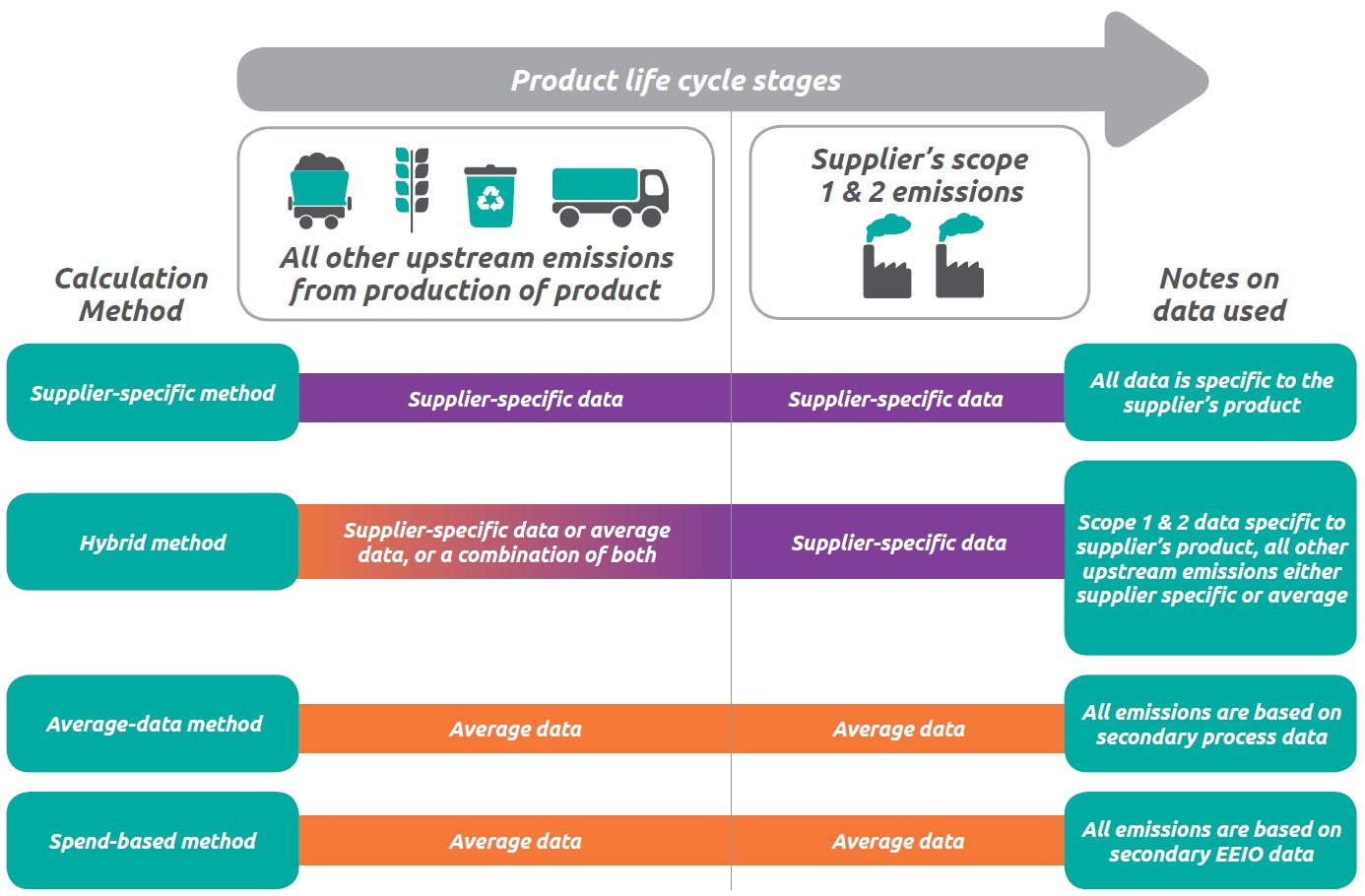
Many organizations estimate these emissions using spend-based approaches, which rely on the monetary value of purchased goods and services combined with sector-average emission factors.
These approaches typically use environmentally extended input–output (EEIO) databases, which link economic sectors to estimated environmental impacts. This methodology offers several advantages:
- It enables the assessment of large purchasing datasets.
- It facilitates calculations when detailed product-level information is not available.
- It provides a systematic and traceable calculation framework.
- It delivers an initial estimate of the emissions associated with the supply chain.
As a result, spend-based approaches are particularly useful as a starting point or baseline assessment, especially when organizations need to calculate emissions across a wide range of purchasing categories and do not yet have product- or supplier-specific data.
Limitations of the spend-based approach
Sector-average emission factors provide a useful starting point for estimating Scope 3 emissions. However, their level of granularity is limited, as they often group very different purchases within the same economic sector. As a result, they cannot adequately distinguish between different technologies, materials, product qualities, manufacturing processes or environmental characteristics of the purchased product or service.
Consequently, two products with significantly different environmental profiles may be assigned the same emission factor simply because they belong to the same economic sector.
This approach also limits the ability to capture the impact of more sustainable purchasing decisions. By applying the same sector-average emission factor across an entire purchasing category, the calculation does not account for specific product characteristics such as material composition, manufacturing technology, recycled content or lower-carbon alternatives.
Moving towards hybrid calculation models
Improving the calculation of Scope 3 supply chain emissions requires moving towards hybrid calculation models that combine different methodological approaches.
The objective is to progressively improve the modelling of supply chain emissions by incorporating more specific emission factors for selected purchasing categories or products. These factors provide a more representative assessment of each product and make it possible to account for key variables that influence its carbon footprint, such as recycled content, the use of low-carbon steel, the electricity mix used during manufacturing or other relevant technological characteristics.
A hybrid calculation model combines:
- Sector-average emission factors based on EEIO databases.
- More specific emission factors for relevant purchases, developed from product-level technical information such as material composition, manufacturing processes and technologies.
The value of more representative hybrid models
For certain purchasing categories, developing product-specific emission factors can significantly improve how accurately purchased products are represented in Scope 3 calculations. Organizations increasingly make sustainable procurement decisions by selecting suppliers and products with a lower environmental impact as part of their supply chain decarbonization strategies.
For example, choosing steel with a higher share of low-carbon content would not be reflected in a calculation based solely on sector-average emission factors. By incorporating product-specific emission factors, these purchasing decisions can be captured in the carbon footprint, allowing organizations to measure and monitor the impact of their decarbonization efforts more accurately.
The role of Scope 3 calculations in climate reporting and decarbonization
Improving the calculation of Scope 3 emissions enhances the representativeness of the results, strengthens understanding of the value chain and provides useful information for climate reporting, risk management, supplier engagement and purchasing decisions.
Organizations need traceable, consistent and verifiable approaches to respond to frameworks such as the GHG Protocol, ISO 14064 and the CSRD. However, these approaches must also support decision-making within the organization itself.
A hybrid model helps move in this direction by maintaining the broad coverage of spend-based approaches while progressively introducing greater precision in areas where more detailed information is available and where there is greater potential for improvement.
At Baisma, we support organizations in calculating, improving and communicating their carbon footprint and environmental impacts. If your company wants to move towards a more robust, traceable and decision-oriented Scope 3 model, we can help you build it step by step.
Contact us.
Insights sugeridos

FAQ | ESPR: Ecodesign for Sustainable Products Regulation

FAQ | Life Cycle Assessment (LCA)
SBTi 2026: Updated guidance for setting and validating science-based targets
