

Climate change is now firmly established as a key factor in business risk analysis. Climate-related threats are becoming more frequent and more severe, leading to loss of life, damage to infrastructure, and disruptions to business operations. While some impacts are already irreversible, reducing greenhouse gas (GHG) emissions can still help limit future effects. At the same time, the regulatory framework driving the transition to a low-carbon economy is becoming increasingly demanding.
Against this backdrop, organizations need to address two dimensions of climate risk: the physical impacts of climate change and the risks linked to the transition towards low-carbon business models. What does this mean in practice?
How does climate change affect organizations?
GHG emissions are altering the climate balance, causing an increase in global average temperatures and significant changes in climate variables. This is resulting in more frequent and more intense extreme weather events.
There is broad scientific consensus linking this phenomenon to human activity. Global mitigation pathways highlight the need to limit warming to 1.5°C in order to avoid particularly severe consequences. The response to this challenge is structured around two main strategies:
- Adaptation: to manage current and future impacts.
- Mitigation: to reduce emissions and limit those impacts.
In this context, an organization’s activities may be affected by:
- Physical risks: arising from the direct impacts of climate change.
- Transition risks: associated with the shift to a decarbonized economy.
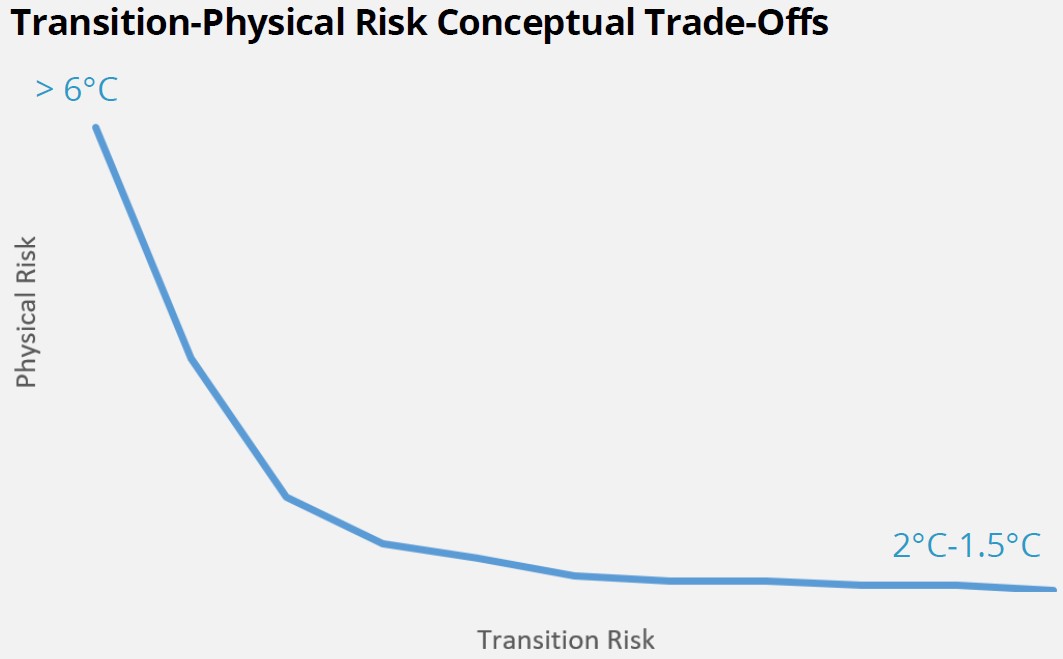
There is a direct relationship between the two: the greater the ambition of the transition, the lower the exposure to physical risks in the long term. This reinforces the need to address both in an integrated way.
Physical risks
Types of physical risks
Physical risks are categorized as follows:
- Chronic physical risks: referring to long-term changes in climate variables such as temperature and precipitation.
- Acute physical risks: referring to those caused by specific events or disasters, such as the increasing severity of extreme weather events like cyclones and floods.
How to identify physical risks?
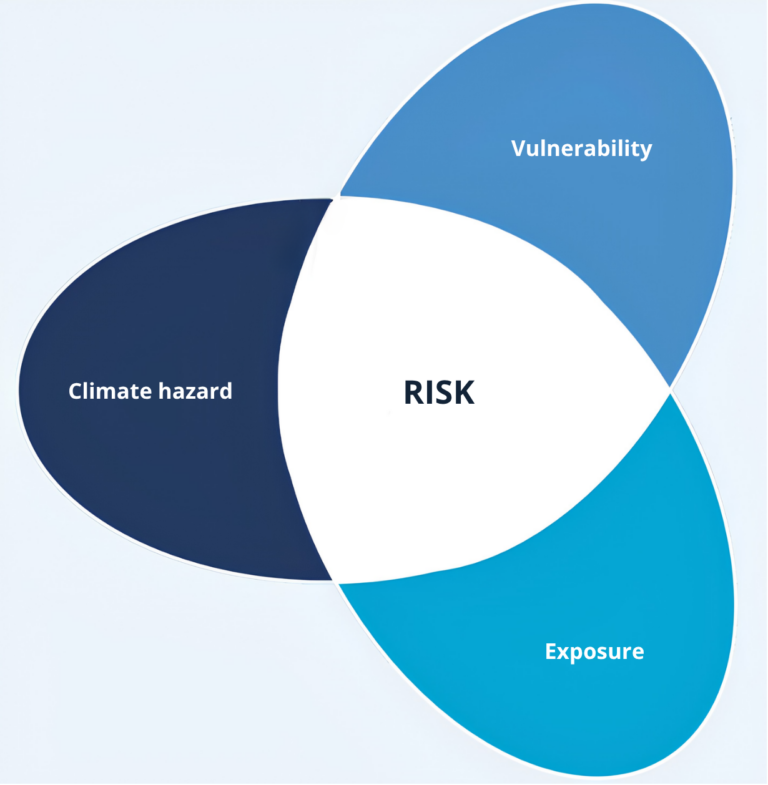
To identify risk, it is essential to consider the combination of three key elements when addressing adaptation: exposure, hazard, and vulnerability. These are defined as follows:
- Exposure: the presence of assets, infrastructure, or activities in areas that may be affected.
- Climate hazard: the likelihood of an adverse climate event occurring.
- Vulnerability: the degree of sensitivity and adaptive capacity in relation to the impact.
The combination of these factors makes it possible to assess the level of risk and prioritize adaptation actions.
Transition risks
Types of transition risks
Transition risks arise from the changes required to move towards a low-carbon economy and can be grouped into the following categories:
- Policy and legal risks: risks related to increasing regulatory requirements on GHG emissions, whether through reporting obligations or compliance with thresholds.
- Examples: increases in GHG emissions pricing, more demanding emissions reporting requirements, mandates and regulation affecting existing products and services, and exposure to litigation.
- Technology risks: risks associated with the adoption of new technologies.
- Examples: replacement of existing products and services with lower-emission alternatives, unsuccessful investment in new technologies, and the cost of transitioning to low-emission technologies.
- Market risks: risks associated with changes in market dynamics.
- Examples: changes in customer behavior, uncertainty in market signals, and rising raw material costs.
- Reputational risks: risks associated with maintaining a reputation that is aligned with evolving market perceptions.
- Examples: changes in consumer preferences, sector stigmatization, increased stakeholder concern, or negative stakeholder feedback.
How to identify transition risks?
The analysis starts with the use of long-term climate scenarios that make it possible to anticipate potential futures. These scenarios, developed by international bodies, help assess how regulatory, technological, and market conditions may evolve.
The main scenarios include:
- Disorderly transition – Delayed or inconsistent climate action that leads to abrupt measures. This results in higher transition costs (e.g. regulatory or energy shocks), despite limiting warming.
- Too little, too late – Delayed action that fails to avoid severe physical risks or high costs. It combines the worst of both worlds: high physical impacts and an equally costly transition.
- Orderly transition – An early and gradual transition towards climate targets (approximately 1.5–2°C). Economic costs are more moderate because changes are planned and abrupt shocks are avoided.
- High-emissions world – Insufficient climate policies leading to high levels of warming (>3°C). Transition costs remain low, but physical impacts are very high, including economic, climate-related, and social damage.
Risk identification begins by analyzing which impacts may materialize under each climate scenario, depending on the organization’s specific context. This involves systematically assessing which changes may affect its activities, whether from a regulatory, technological, or market perspective.
Based on this analysis, risks are prioritized according to two variables: the magnitude of the impact and the likelihood of occurrence. This approach makes it possible to focus efforts on those risks with the greatest potential to affect the organization’s performance.
How to address these risks?
The identification of climate risks must lead to concrete adaptation measures that strengthen the resilience of infrastructure and services. It is important to anticipate both regulatory changes and the conditions posed by different future scenarios.
In addition, getting ahead of these risks also makes economic sense, since acting early is usually more efficient than reacting later, especially when it comes to future regulatory requirements or physical impacts that can become more costly if they are not managed in time.
For this to work, the analysis must be integrated into the core of the organization and become part of decision-making. Incorporating the climate dimension from the outset makes it possible to steer activities towards more resilient and lower-carbon business models, rather than addressing these issues reactively.
Regulatory framework and relationship with other metrics
Assessing physical and transition climate risks is not only a matter of good management practice, but also of complying with an increasingly demanding regulatory framework. In Spain, Law 7/2021 on climate change and energy transition establishes, in Article 32, the obligation to assess these risks and their financial impact, reinforcing the importance of integrating environmental and climate metrics into corporate analysis.
Organizations should also consider including metrics on climate-related risks and those associated with the management of water, energy, land use, and waste, where relevant and appropriate. In particular, this highlights the need to provide:
- Carbon footprint: Scope 1 and 2 GHG emissions and, where necessary, Scope 3 GHG emissions and the related risks.
- Climate-related targets: setting science-based targets enables organizations to establish greenhouse gas emissions reductions aligned with a 1.5°C scenario.
Other metrics are also particularly relevant, such as:
- Environmental footprint – enables the assessment of risks related to energy, waste, and similar aspects.
- Comprehensive water footprint – enables the assessment of risks related to water management.
Having a clear view of the climate risks a company faces makes it possible to anticipate potential impacts and prepare with the right context to manage them.
At Baisma, we help identify both physical risks and transition risks linked to the shift towards a low-carbon economy. The next step is clear: to turn that diagnosis into operational and strategic decisions that reduce risk exposure and strengthen business resilience.
Interested? Get in touch with our team.
Insights sugeridos
FAQ | ESPR: Ecodesign for Sustainable Products Regulation

FAQ | Life Cycle Assessment (LCA)
SBTi 2026: Updated guidance for setting and validating science-based targets
