
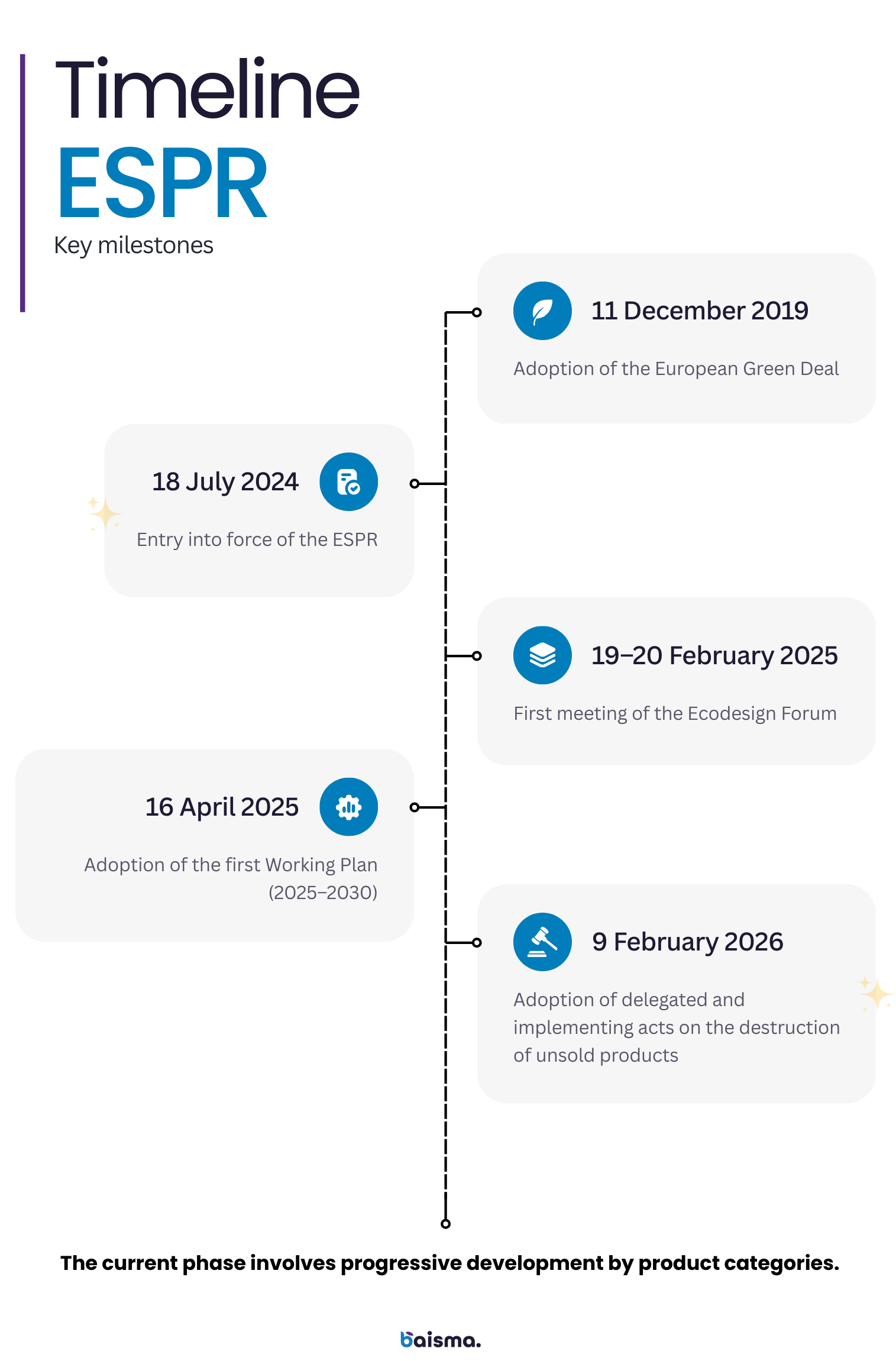
Regulation (EU) 2024/1781 on Ecodesign for Sustainable Products (ESPR), in force since 18 July 2024, establishes the regulatory framework that will progressively introduce sustainability requirements for most products placed on the EU market.
It is a framework regulation that sets out the legal architecture for defining environmental requirements by product category over the coming years, through the gradual adoption of delegated and implementing acts.
Background and purpose
The Regulation forms part of the implementation of the 2020 Circular Economy Action Plan under the European Green Deal and responds to the need to establish regulatory instruments that act on product design and marketing in order to reduce their environmental and climate footprint.
The Regulation pursues three main objectives:
Improve product circularity and durability.
Reduce their environmental and climate footprint.
Strengthen the internal market by preventing regulatory fragmentation among Member States.
In addition, it contributes to broader structural goals such as:
Doubling the circular material use rate.
Improving energy efficiency.
Reinforcing European industrial competitiveness.
What’s new compared to the previous Directive?
The ESPR replaces Directive 2009/125/EC on ecodesign.
The expansion is twofold:
1) Expansion of scope
The former Directive was limited to energy-related products.
The ESPR extends its scope to almost all physical products, with limited exceptions (such as food, feed and medicinal products).
2) Expansion of requirements
The focus is no longer limited to energy efficiency.
Future requirements may address, among other aspects:
- Durability and reparability
- Recyclability and recycled content
- Presence of substances that hinder circularity
- Carbon and environmental footprint
- Waste generation
- Availability of sustainability information
The Regulation does not set these requirements directly. Instead, it establishes the legal basis for their development through delegated acts adopted for specific product categories.
Main regulatory tools introduced by the ESPR
Beyond future ecodesign requirements, the Regulation establishes new structural tools to support its implementation:
▸ Digital Product Passport (DPP)
The ESPR introduces the Digital Product Passport (DPP) as an infrastructure designed to structure and make available relevant product information throughout the product’s life cycle.
The DPP is intended to enable harmonised access to technical, environmental and traceability data defined in delegated acts for each product category. Its objective is to facilitate circularity, enhance transparency and strengthen the effective enforcement of ecodesign requirements.
The technical specifications — including data scope, format, interoperability and access conditions — will be progressively defined through delegated acts.
▸ Transparency obligations and a potential EU-wide environmental label
The ESPR empowers the Commission to establish, through delegated acts, information and labelling requirements applicable to specific product categories.
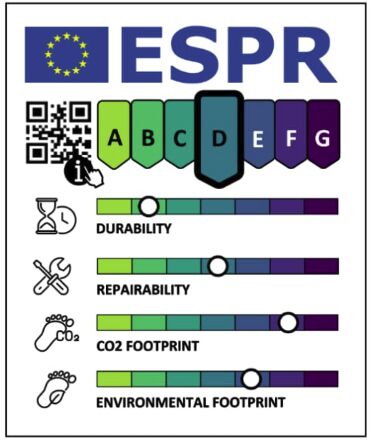
The Regulation does not create an environmental label with a predefined format in its core text. The specific set-up — including the indicators covered, the display system, the level of comparability or any potential rating scheme — will depend on the delegated acts adopted for each product group.
In parallel to the regulatory development, the Commission has launched technical work and public consultations to explore possible visual models for presenting environmental information, in line with the Regulation’s approach and avoiding overlaps with existing schemes such as energy labelling.
From a regulatory perspective, these information requirements may serve a dual function:
- Making visible certain environmental performance parameters defined by category (e.g., durability, reparability, recycled content or environmental footprint).
- Strengthening comparability between products within the internal market, in line with the ESPR’s harmonisation objectives.
Any future label would act as a structured communication mechanism for the market, while the Digital Product Passport (DPP) will provide the technical infrastructure to support and structure the underlying data.
The specific scope will be defined based on the 2025–2030 Working Plan and the delegated acts adopted for each product category.
▸ Prohibition on the destruction of unsold consumer products
The ESPR introduces a direct restriction on the destruction of certain unsold consumer products through a delegated act published on 9 February 2026.
In a first phase, the prohibition will apply to textiles and footwear as of 19 July 2026 for large companies, and from 19 July 2030 for medium-sized companies. Micro and small enterprises are excluded.
The Commission may extend this prohibition to other categories through delegated acts, based on criteria such as environmental impact, the volume of unsold goods, or the potential for reuse and recycling.
The measure is not limited to a formal restriction. It is structured together with:
- Obligations to disclose standardised information on discarded products.
- The definition of justified exemptions (safety, health, intellectual property or legal obligations).
- A verification framework to be enforced by national authorities.
The progressive extension to additional categories will depend on the Commission’s working plan and on the evolution of the regulatory framework in the coming years.
▸ Public procurement rules supporting sustainability objectives
The ESPR empowers the Commission to establish, through delegated acts, mandatory Green Public Procurement criteria for specific product categories.
This means that, for products covered by specific ecodesign requirements:
- Minimum sustainability criteria may be set, which public authorities will be required to apply in their procurement procedures.
- Such criteria will be harmonised at EU level to prevent fragmentation among Member States.
- The role of public demand as a lever to accelerate market transformation will be strengthened.
In addition to allowing voluntary guidance, the Regulation supports the introduction of binding requirements for the public sector in relation to prioritised products.
From a regulatory perspective, this creates a dual pressure:
1) Design requirements for access to the general market.
2) Additional or reinforced requirements for access to the public procurement market.
How will the ESPR be implemented?
The ESPR is a framework legislation.
Its real impact will depend on the delegated and implementing acts that are progressively adopted.
The process includes:
- Product prioritisation exercise.
- Multiannual working plan.
- Preparatory studies.
- Impact assessment.
- Consultations in the Ecodesign Forum.
- Formal adoption by the Commission.
In April 2025, the first ESPR and Energy Labelling Working Plan 2025-2030 was adopted, establishing the priority product categories for the coming years. The selection is based on criteria such as:
• high environmental impact throughout the life cycle,
• high potential for improvement in terms of circularity,
• significant weight in the internal market,
• strategic relevance for European industrial competitiveness.
In the first prioritisation cycle, the following are included, among others:
• Textiles
• Furniture
• Mattresses
• Tyres
• Iron and steel
• Aluminium
What are the strategic implications?
The ESPR does not introduce a one-off obligation, but rather a dynamic regulatory framework that will be progressively deployed across product categories.
Its impact is not limited to formal compliance with a technical requirement. It affects multiple organizational layers:
• Product design, insofar as future delegated acts may establish requirements related to durability, reparability, recyclability, or recycled content.
• Selection of materials and components, particularly where restrictions on substances that hinder circularity or minimum environmental performance requirements are introduced.
• Traceability and data structuring, in alignment with the development of the Digital Product Passport.
• Information obligations and possible labelling, which may make certain environmental parameters visible to the market.
• Inventory and surplus management, particularly following the prohibition on the destruction of unsold products.
• Internal data governance, since compliance will require consistency across technical, legal, sustainability, and operational areas.
In this context, adaptation involves complying with the requirements established once specific delegated acts enter into application, understanding the system’s underlying logic, and anticipating how the different regulatory instruments will interact with one another.
If your organization places products on the EU market, now is the time to:
- Identify which product categories may be prioritized.
- Review internal calculation and traceability capabilities.
- Anticipate the interaction between design requirements, the DPP, and potential labelling systems.
At Baisma, we support public entities, private companies, and industry associations in turning this roadmap into environmental competitiveness through forward-looking strategies in circularity, ecodesign, and transparency.
Insights sugeridos

Integrating biodiversity and natural capital into corporate strategy

Global Circularity Protocol v1.0: What it is and how it applies to business

Circular economy indicators: basics, frameworks and how to apply them
