
The circular economy aims to redefine growth by decoupling it from the consumption of finite resources, through strategies such as reuse, life-extension, and material recovery. To ensure this approach has a real impact in practice — across organizations, products, territories, and value chains — it is essential to measure its implementation in a structured way.
In this context, circular economy indicators have become key tools to understand, measure, and manage circularity in a rigorous and practical manner.
This Insight explores how circularity assessments and frameworks such as the Circular Transition Indicators (CTI v4.0) or the ISO 59000 series enable organizations to establish a quantifiable and strategic foundation for their circular transition.
What are circular economy indicators?
They are metrics designed to quantify the extent to which an organization, product, or system adopts circular practices. They go beyond recycling or waste reduction, encompassing aspects such as reuse, repairability, life extension, use of secondary materials, and the ability to close resource loops. Their value lies in translating a complex concept into concrete, actionable, and comparable indicators.
Why are they important?
Enable the establishment of baselines and measurable targets.
Help identify improvement opportunities throughout the product or process life cycle.
Strengthen the credibility of sustainability reports.
Facilitate decision-making and compliance with emerging regulatory frameworks such as the CSRD, the EU Taxonomy, and other reporting frameworks that integrate circularity metrics.

Key reference frameworks
Circular Transition Indicators (CTI v4.0)
Developed by the World Business Council for Sustainable Development (WBCSD), the CTI provide a standardized quantitative methodology that enables companies to measure and communicate their circular performance. They are structured around four modules:
Close the loop: evaluates the share of materials entering and leaving the system that have a circular origin or destination (recycled, reused, renewable).
Optimize the loop: considers resource efficiency, material criticality, and the ability to extend product lifespan.
Value the loop: analyzes the economic value associated with circular versus linear materials.
Impact the loop: estimates the environmental benefits derived from increased circularity, such as reduced emissions or resource use.

The latest version (v4.0) enables the calculation of metrics that can support reporting requirements under other frameworks such as GRI 301/306, ISO 59020, or the CSRD. This facilitates integration into existing reporting systems without duplicating efforts. It also allows organizations to tailor the level of detail according to their own maturity and that of their value chain.
ISO 59000: international standards on circular economy
The ISO 59000 series provides an international framework for implementing and assessing the circular economy in a consistent and comparable way. To date, the following standards have been approved: ISO 59004, ISO 59010, ISO 59014, ISO 59020, and ISO 59040. Others, such as ISO/CD TR 59031 (case studies) and ISO/CD TR 59032.2 (business model implementation review), are still under development.
This series is characterized by its cross-cutting approach, as it does not replace existing management systems but integrates with them (e.g., ISO 14001, ISO 9001). It promotes continuous improvement and a life-cycle perspective, considering circularity from resource extraction to the product’s end of life. It can also be adapted to different sectors and organizational maturity levels.
The ISO 59000 series does not impose a single measurement methodology, but is compatible with tools such as CTI or MCI, facilitating its adoption according to each organization’s context.
It is composed of several key documents:
ISO 59004:2024 – establishes the terminology, principles, and general guidelines for implementing the circular economy. It applies to organizations of any type or size and provides a common reference framework for its application.
ISO 59010:2024 – provides guidance on integrating circularity into business models and value networks. It is aimed at organizations working with products or services and offers a methodology to assess and redesign their systems toward more circular models.
ISO 59014 – sets out principles and requirements for the sustainable and traceable use of secondary materials. It targets economic operators managing recovered materials and aims to promote their efficient reuse.
ISO 59020:2024 – defines the requirements for objectively and reliably measuring and assessing circularity. It includes both quantitative and qualitative indicators to analyze inputs, outputs, waste, water, energy, and economic aspects. It does not impose specific scopes or indicators but provides a framework for organizations to determine which measurement areas and indicators are most relevant to their context.
ISO/CD TR 59031 – a technical report under development that will include performance-based case studies, providing successful examples of circular economy implementation. It is informative rather than normative, as it is classified as a Technical Report (TR).
ISO/CD TR 59032.2 – focuses on reviewing and inspecting the implementation of circular models. It provides guidance that encourages resource reuse and continuous improvement in industrial processes.
ISO 59040 – offers a methodology for developing product circularity data sheets, facilitating information exchange among actors along the value chain.
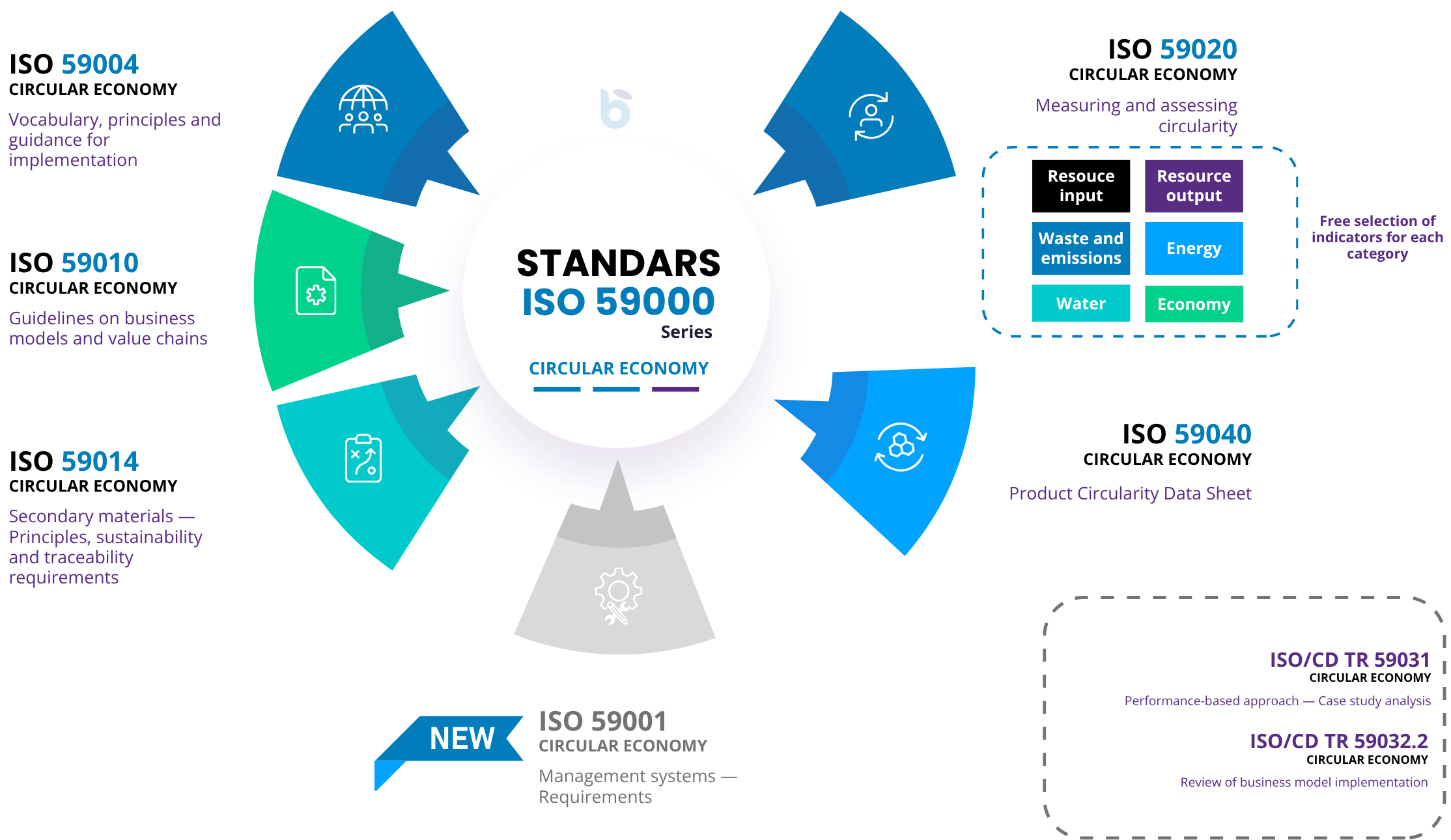
The most recent addition is ISO 59001, currently under development, which will set the requirements for implementing a certifiable circular economy management system. Its publication will represent a qualitative leap, as it offers a framework aligned with standards such as ISO 9001 and ISO 14001, enabling the integration of circular practices into existing management systems. Although its final version is still pending, its progress marks a milestone: it will be the first standard aimed at external verification of circularity at the organizational level.
How is a circularity assessment applied?
A circularity assessment is a technical tool that helps organizations understand their current situation regarding circularity, identify improvement areas, and define a roadmap. Its application may vary depending on the sector, size, or complexity of operations, but generally includes the following stages:
System boundaries: defining the scope of the assessment. It may focus on a business unit, a production plant, a supply chain, or a specific product. This definition directly affects the required data and the interpretation of results.
Data inventory: gathering quantitative and qualitative information on input flows (raw materials, water, energy), processes (consumption, generated waste, by-products), and outputs (products, emissions, recoverable waste). This phase often requires interdepartmental collaboration and may involve suppliers or external partners.
Indicator selection: depending on the chosen framework (CTI, ISO 59020, or others), the most relevant indicators for the analyzed system are selected. The choice should balance representativeness, data availability, and ease of monitoring.
Analysis and prioritization: interpreting the results from a strategic perspective. It’s not only about “measuring” but about identifying bottlenecks, redesign opportunities, critical dependencies on resources or emissions, and potential process synergies.
Integration into strategy: translating the findings into action. This involves defining improvement actions, incorporating circularity goals into corporate strategy, and setting up mechanisms for periodic monitoring and updates.
At Baisma, we support organizations and territories that want to build real systems for measuring and improving circular economy performance. We help define the right approach, select indicators, and design a strategy aligned with international frameworks.
Contact us.
Insights sugeridos
Ecodesign for Sustainable Products Regulation (ESPR)

Integrating biodiversity and natural capital into corporate strategy
Global Circularity Protocol v1.0: What it is and how it applies to business
