

More efficient equipment, monitoring systems, electrification solutions, or technologies that replace more carbon-intensive processes are some examples of solutions that are often associated with claims related to greenhouse gas emission reductions.
However, quantifying this benefit requires a specific analysis that goes beyond the product carbon footprint: it depends on the reference scenario, the methodological assumptions, and aspects such as system boundaries or potential double counting.
In this context, the recent publication of IEC 63372:2026 provides a specific framework for quantifying and communicating the carbon footprint of electrical and electronic products and systems, including emission reductions and avoided emissions.
What are avoided emissions?
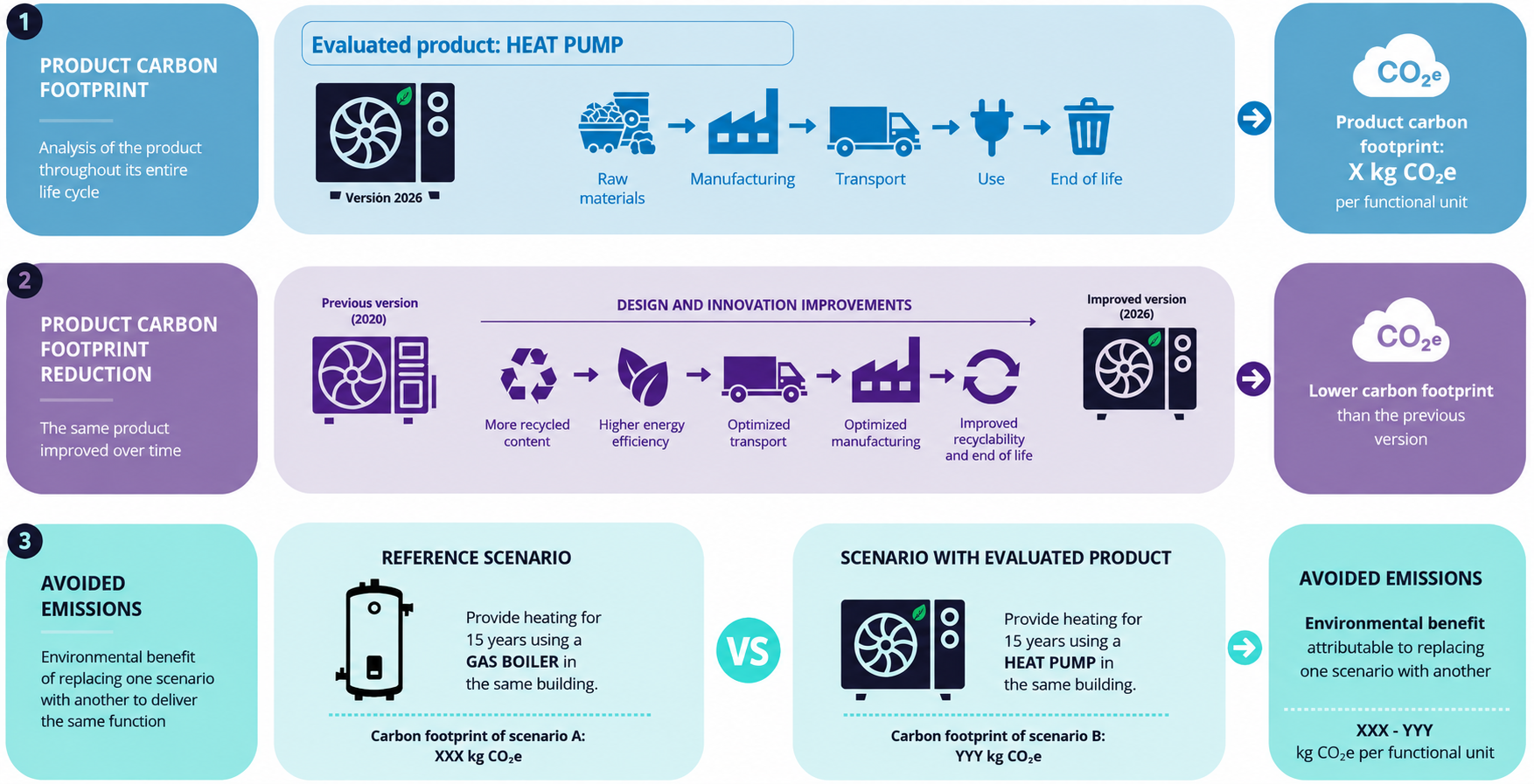
A product carbon footprint answers a very specific question: how many greenhouse gas emissions are associated with this product throughout its life cycle? From raw material extraction to end of life. It is an analysis intrinsic to the product.
Avoided emissions, on the other hand, answer a different question: what is the difference in emissions between the system that includes this product and an alternative reference scenario? The focus is no longer on the product itself, but on the change in the system that occurs when it replaces another technology or solution.
Therefore, this analysis only makes sense when there is a clear and justifiable substitution between scenarios: for example, the electrification of processes that previously relied on fossil fuels. The methodological key lies in defining the reference scenario and comparing functionally equivalent scenarios, as this comparison ultimately determines the result.
What does IEC 63372:2026 bring to the table?
The calculation of avoided emissions depends on the methodological choices made for the comparison. Key aspects that need to be defined include:
- The reference scenario: the alternative against which the product or system is compared.
- The assumptions of the analysis: such as service life or operating conditions, among others.
- The system boundaries: which processes and life cycle stages are included in the assessment.
- The prevention of double counting: particularly when different actors within the same value chain could claim the same emission reduction.
Two assessments of the same product may produce different results if they are based on different scenarios or assumptions. IEC 63372:2026 addresses the need for common methodological criteria and establishes a framework for transparently documenting the assumptions used, defining reference scenarios and communicating results consistently. Its objective is not to maximize the reductions obtained, but to provide a methodology that enables studies to be comparable, traceable and verifiable.
IEC 63372 and ISO 14067: how do they differ?
ISO 14067 remains the international reference for the quantification and communication of a product carbon footprint, i.e. the greenhouse gas emissions associated with a system throughout its life cycle. The footprint may implicitly reflect efficiency improvements or reductions compared with previous and/or alternative scenarios, but it does not provide specific guidance for calculating avoided emissions.
IEC 63372 specifically develops an approach for electrical and electronic products and systems that distinguishes and structures three concepts which, although related, are not equivalent: product carbon footprint, emission reductions and avoided emissions. It therefore provides a methodological framework for calculating and reporting them when they are relevant to the environmental performance of the system.
IEC 63372 within the IEC standards family
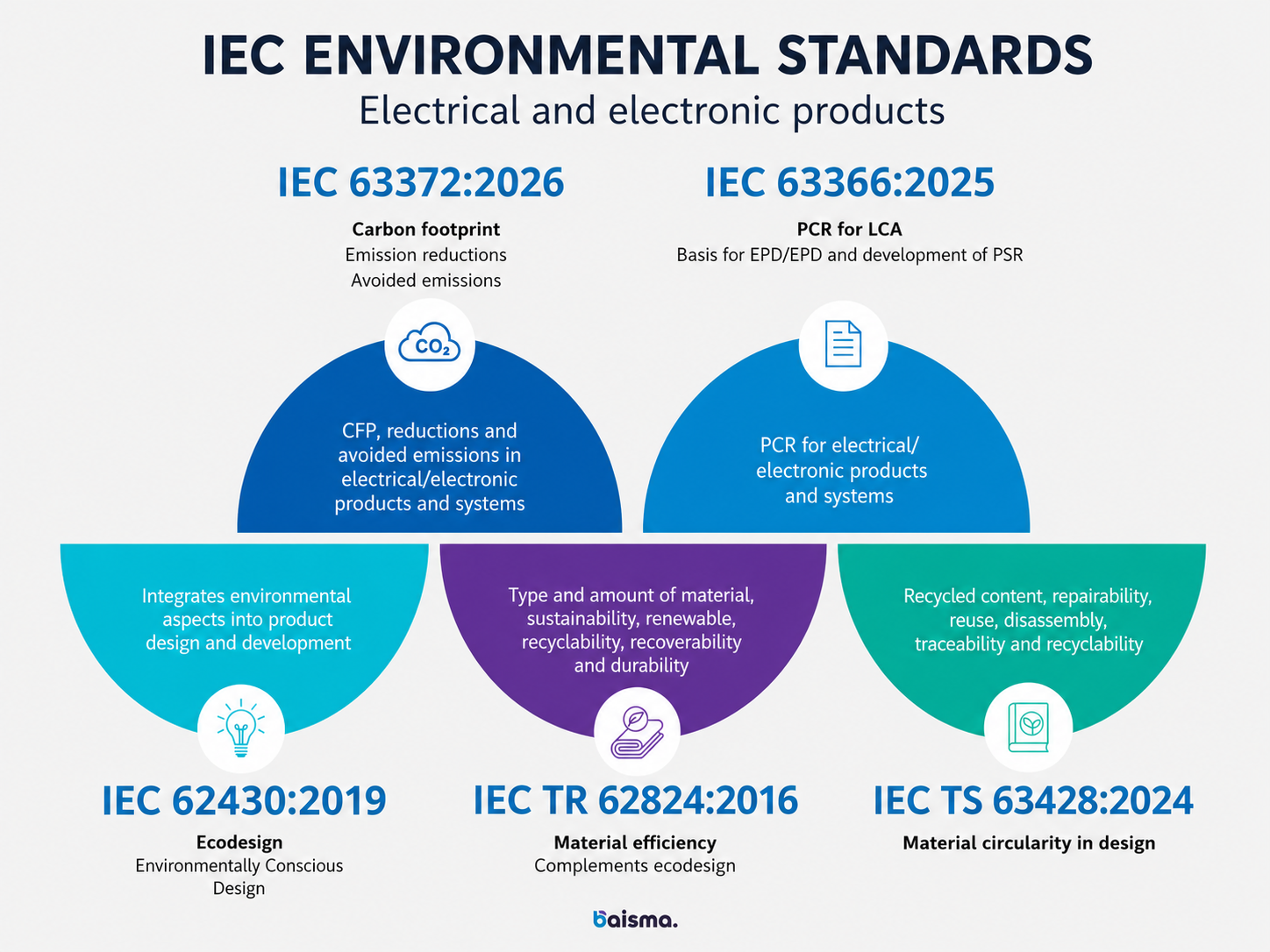
IEC 63372 is part of a broader set of standards aimed at the environmental assessment of electrical and electronic products and systems. This family of standards addresses different aspects of environmental performance throughout the life cycle, from product design to the communication of results.
Some of the most relevant standards include:
- IEC 63366 – Establishes rules for the life cycle assessment (LCA) of electrical and electronic products and systems and provides a basis for the development of product category rules and environmental product declarations (EPDs).
- IEC 62430 – Focuses on integrating environmental considerations into product design and development (ecodesign).
- IEC TS 63428 – Provides guidelines for incorporating material circularity aspects, such as reparability, reuse, recycled content and recyclability.
Together, these standards not only support impact quantification but also provide tools for integrating environmental considerations into product design, facilitating the communication of environmental information and addressing aspects such as circularity and avoided emissions through harmonized methodologies.
Quantifying avoided emissions can provide valuable information about a product’s environmental contribution, provided that it is based on a robust methodology and clearly defined assumptions.
At Baisma, we help organizations assess and communicate the environmental performance of their products using recognized methodologies tailored to each case, from product carbon footprints to comparative studies and environmental declarations.
Insights sugeridos

FAQ | ESPR: Ecodesign for Sustainable Products Regulation

FAQ | Life Cycle Assessment (LCA)

SBTi 2026: Updated guidance for setting and validating science-based targets
