

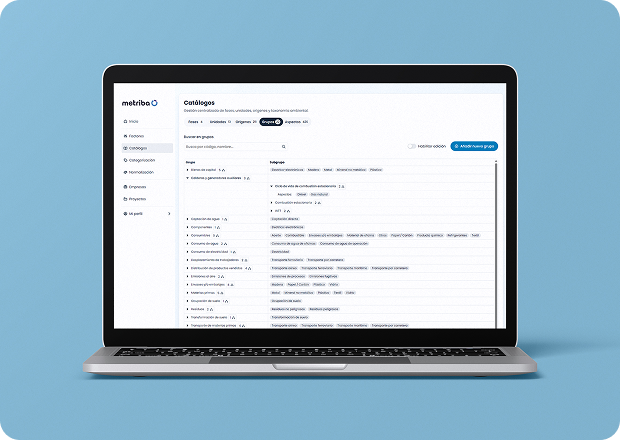



Centralize, calculate, and analyze the environmental performance of your organization, products, and value chain from a single environment.
Multicriteria environmental assessment
Metriba enables the assessment of environmental performance dimensions based on a common information foundation, integrating various metrics under a unified analytical approach.
Environmental metrics
METRIBA integrates various evaluation methodologies to analyze an organization’s impacts and resource use from a multi-criteria perspective.
Quantify the greenhouse gas emissions associated with the organization's activity.
GHG emissions - kg CO2e
Evaluate different categories of environmental impact to gain a broader perspective than just climate change.
Multiple impact categories
Analyze the relationship between the organization's activity and its impacts on biodiversity.
Impacts on biodiversity
Evaluate resource use and material flows to analyze the organization's circular performance.
Circularity indicators
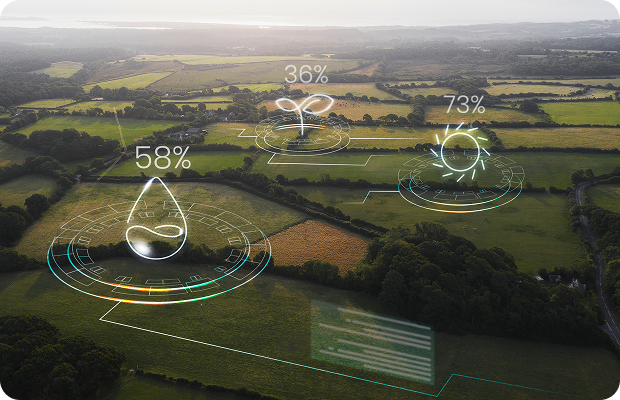
It integrates different dimensions of environmental performance to help you understand where impacts are concentrated, identify priority areas for action, and establish a solid foundation for environmental management.
01.
Identify which activities and flows make the greatest contribution.
02.
Analyze performance without limiting the evaluation to a single metric.
03.
Maintain a structured foundation for management, tracking, and reporting.
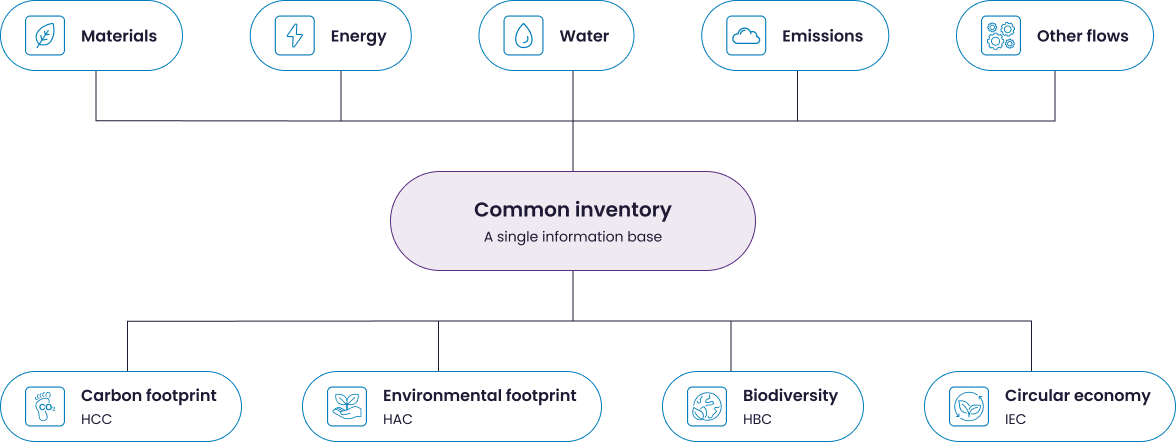
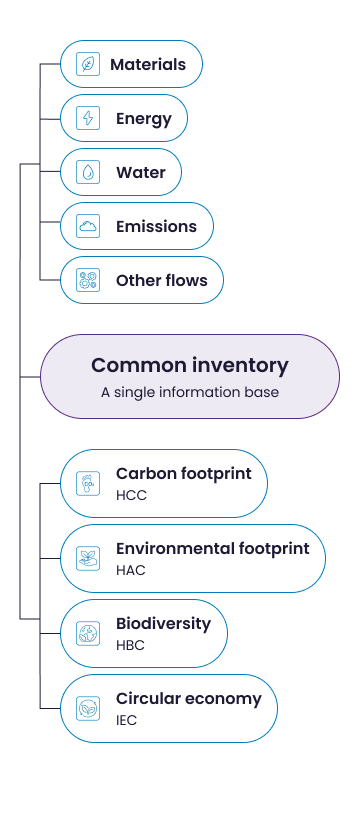
METRIBA enables the assessment of various dimensions of an organization’s environmental performance, including the Organizational Carbon Footprint (OCF), the Organizational Environmental Footprint (OEF), the Organizational Biodiversity Footprint (OBF), and Circular Economy Indicators (CEI).
METRIBA starts with data related to an organization’s key flows—such as materials, energy, water, emissions, waste, and other relevant resources or activities—which are organized into a common inventory used for all metrics.
METRIBA applies recognized methodologies and frameworks tailored to each specific metric. For the quantification of greenhouse gas emissions, it uses ISO 14064-1 as a reference, while environmental assessment is based on the life cycle approach—incorporating ISO 14072:2024 for its application to organizations—as well as life cycle inventory databases for specific calculations.
For biodiversity assessment, it draws upon frameworks such as the Natural Capital Protocol – Biodiversity Guidance (2020) and the Partnership for Biodiversity Accounting Financials (PBAF) – Biodiversity Footprinting Standard: Financed Impact (2024).
Regarding the circular economy, it incorporates frameworks such as ISO 59020:2024 and the WBCSD’s Global Circularity Protocol for Business (GCP) for the measurement and management of circular performance.
Yes. METRIBA adopts a life-cycle perspective, allowing for the consideration of both the organization’s direct operations and its upstream and downstream value chain activities—from the extraction and processing of raw materials to the use and end-of-life stages of products or services.
Yes. METRIBA is designed to maintain the traceability of data and calculations, including inventory management, information flow, the factors and conversions used, and aspects related to data quality and uncertainty.
The assessment is based on the flows, activities, and relevant characteristics of each organization, making it possible to build an inventory that reflects its specific reality and to apply the most pertinent environmental metrics. Furthermore, METRIBA can be adapted to the specific needs and requirements of each organization and sector.
You can currently request access to METRIBA via our contact form. We will analyze your organization’s needs and requirements to define the scope of the solution and prepare a tailored proposal.
This website uses cookies
We use cookies to personalise content and ads, to provide social media features and to analyse our traffic. We also share information about your use of our site with our social media, advertising and analytics partners who may combine it with other information that you've provided to them or that they've collected from your use of their services.
Necessary
Necessary cookies help make a website usable by enabling basic functions like page navigation and access to secure areas of the website. The website cannot function properly without these cookies.
Preferences
Preference cookies enable a website to remember information that changes the way the website behaves or looks, like your preferred language or the region that you are in.
Statistics
Statistic cookies help website owners to understand how visitors interact with websites by collecting and reporting information anonymously.
Marketing
Marketing cookies are used to track visitors across websites. The intention is to display ads that are relevant and engaging for the individual user and thereby more valuable for publishers and third party advertisers.
Cookies are small text files that can be used by websites to make a user's experience more efficient.
The law states that we can store cookies on your device if they are strictly necessary for the operation of this site. For all other types of cookies we need your permission.
This site uses different types of cookies. Some cookies are placed by third party services that appear on our pages.
You can at any time change or withdraw your consent from the Cookie Declaration on our website.
Learn more about who we are, how you can contact us and how we process personal data in our Privacy Policy.
Please share your email with us so we can send you our services brochure

Need more information? Feel free to contact us with no obligation
Would you like a demo of Metriba? Get in touch with us—no strings attached
Would you like a demo of Double Materiality? Get in touch with us, no strings attached.