
Manage double materiality from start to finish
Identify, evaluate, and prioritize impacts, risks, and opportunities, and connect the results with the information needed for decision-making and reporting.
Double materiality analysis
Double materiality
beyond reporting
Identify which sustainability issues are relevant to the organization and use the results to set priorities and guide decision-making.
Identify
Impacts, risks, and opportunities arising from the organization’s context.
Evaluate
Analyze impact and financial materiality using consistent criteria.
Prioritize
Determine which issues require attention and what information needs to be managed.

Information management
From material matters to the information that is truly necessary
Materiality results make it possible to focus management and reporting on truly relevant information, understand what is already covered, and identify what still needs to be developed.

Sustainability topics
E1 • E2 • E3 • E4 • E5 • S1 • S2 • S3 • S4 • G1 ...
Double materiality analysis
Topics and subtopics
The results make it possible to focus the analysis on relevant issues.
Information requirements
Information to be managed
Priority is given to information related to material topics.
Coverage analysis
Status of the information
Available
Cover information
Partial
Incomplete information
Gap
Information not available
Convert the analysis results into objectives and actions
Centralize the substantive matters, justifications, sources, and evidence used during the analysis, facilitating their review, updating, and monitoring. Translate the analysis results into objectives and actions, assign responsibilities, and track progress using indicators.
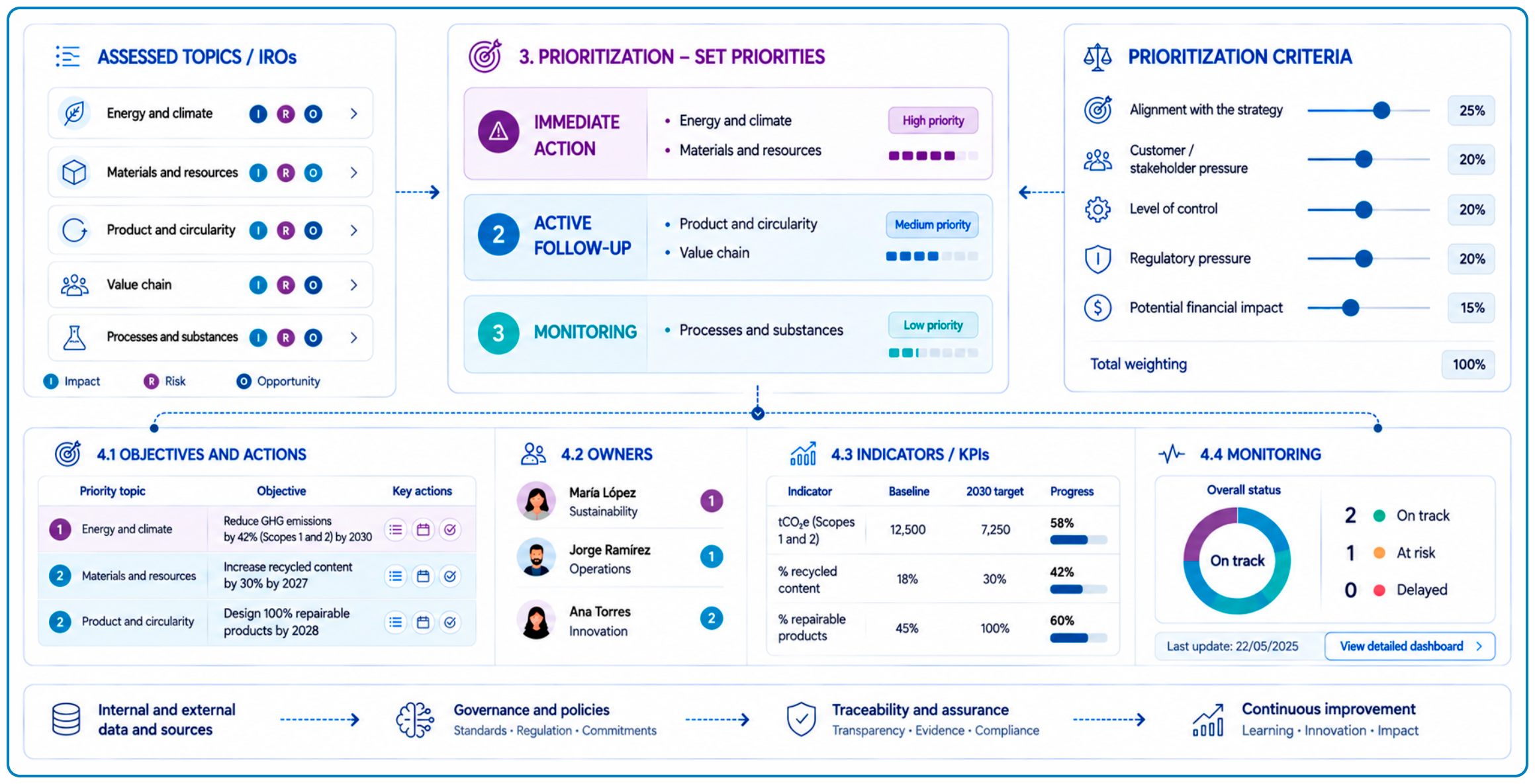
Aligned with the ESRS and EFRAG guidance
The solution structures the double materiality analysis in accordance with the ESRS and EFRAG guidance, linking materiality results to information relevant for sustainability reporting.
IRO
Impacts • Risks • Opportunities
Dual materiality
Impact + Financial
Topics materials
Topics + Subtopics
Relevant information
DR + Datapoints
Reporting
Management + Monitoring
FaQ
What is double materiality analysis?
Double materiality analysis allows for the identification and assessment of relevant sustainability issues from two perspectives: the organization’s impacts on people and the environment, and the risks and opportunities that these issues may create for the organization.
Is the solution aimed solely at companies required to report under the CSRD?
No. Double materiality also makes it possible to identify sustainability priorities, guide decision-making, and structure information relevant for management—regardless of whether there is a direct reporting obligation.
Is the solution aligned with the ESRS?
Yes. The solution structures the double materiality analysis in accordance with the ESRS and EFRAG guidance, incorporating the identification and assessment of impacts, risks, and opportunities, as well as the determination of material topics.
Does the solution help determine what information needs to be reported?
Yes. Based on the materiality results, it allows for linking material topics and subtopics with the corresponding disclosure requirements, and focusing reporting on relevant information.
Does it allow for the identification of information gaps?
Yes. The solution makes it possible to analyze the extent to which necessary information is covered, distinguishing between information that is available, partial, or pending, and identifying gaps that require further development.
Can the analysis be updated over time?
Yes. The information, assessments, justifications, and evidence are structured to facilitate the review and updating of the analysis whenever the organization’s activities, context, or priorities change.
Can the solution connect to the organization's data?
The solution is designed to centralize and work with information from various sources. Integration capabilities can be tailored to the systems and needs of each organization.
Can it be integrated with METRIBA?
Yes. Integration with METRIBA allows for the use of pre-structured environmental data and the results of environmental metrics as a foundation for analysis, linking environmental assessment with the identification and management of impacts, risks, and opportunities.
Is it necessary to have a double materiality analysis in place beforehand?
No. The solution allows for the structuring of the process, from the initial identification of impacts, risks, and opportunities through to their evaluation, prioritization, and monitoring.
Can existing analyses or information be incorporated?
Yes. The solution allows you to build upon the organization’s existing information and previous work, facilitating its integration into the analysis and avoiding the need to reconstruct the process from scratch.
What happens once the material topics have been identified?
The solution enables the translation of identified priorities into management, by defining objectives and actions, assigning responsibilities, and monitoring progress through indicators.
